















| |
 |
Undergraduate Research in
Earth, Oceans and Space Science to be Showcased April 28 at UNH
Contact: David Sims
603-862-5369
Science Writer
Institute for the Study of Earth, Oceans, and Space
April 22, 2004

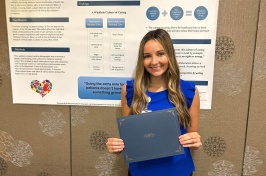
DURHAM, N.H. -- Last January, when University of New Hampshire senior
Meredith Bailey presented her work at the American Geophysical Union's
Ocean Sciences Conference in Portland, Oregon, most of the scientists
and professors assumed she was describing graduate-level research.
It was an understandable error given the nature of Bailey's work,
which, she explains, involves “looking for evidence of cryptic
speciation in the calanoid copepod Acartia tonsa by sequencing
a mitochondrial gene from individuals I collected throughout the
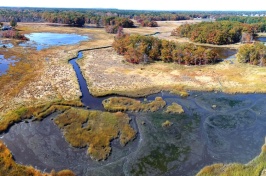
summer on New Hampshire's Great Bay and from estuaries in Maine,
Massachusetts, and Rhode Island.”
Bailey will present her research on Acartia tonsa - a
common species of zooplankton or “bug” found in the
regions' coastal waters - at UNH's Institute for the Study of Earth,
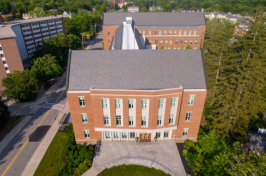
Oceans, and Space Wednesday, April 28, 2004. The symposium will
be held in Durham in Morse Hall as part of the weeklong, fifth annual
Undergraduate Research Conference featuring work by students from
all of the university's schools and colleges.
Students will present their work through poster sessions in the
Morse Hall atrium. Presentations will encompass a broad range of
topics, including climate change in New Guinea, the chemical makeup
of deep-sea hydrothermal vents, and instrument design for a future
NASA mission.
“Many of today's scientific challenges are highly complex
and require an increasingly interdisciplinary perspective and
set
of skills. This event will recognize outstanding student research
now, and help to foster the broad perspective and skills needed
by future scientific leaders,” says symposium organizer George
Hurtt, assistant professor in EOS and the Department of Natural
Resources.
Bailey's undergraduate research began in the second
semester of her freshman year when she started working in the Ocean
Process
Analysis Laboratory at EOS. This past summer, for her senior, honors
thesis, she applied for and was awarded an Undergraduate Research
Opportunity Program Summer Undergraduate Research Fellowship. This
funded her research on Acartia tonsa - an animal, Bailey
has discovered, that is in the process of evolving into two distinctly
separate species.
Explains Bailey, “I compared gene sequences of the individuals
between different estuaries, and found that north of Cape Cod the
genetic signature of A. tonsa is very different from those
found south of Cape Cod. This indicates that these may not be the
same species, or, that they were once the same species but are now
diverging into separate species.”
Of her undergraduate research experience at UNH Bailey adds, “People
from other schools are often amazed at the level of student research
that goes on here, but I almost take it for granted. Because, to
me, it's no big deal to be a junior or sophomore or even a freshman
and just walk into a lab and start doing science.”
For more
information visit www.unh.edu/urc.
|