


















| |
 |
UNH History Department Hosts
Conference
On Post 9/11 World
Contact: Erika Mantz
603-862-1567
UNH Media Relations
Sept. 7, 2005

DURHAM, N.H. -- Terrorism and its impact on liberal democracy will
be the focus of a conference sponsored by the University of New
Hampshire’s history department Sept. 29-30, 2005. Supported
by the Dunfey Endowment for the Study of History, the conference
will bring together some of the world’s most distinguished
historians and journalists to consider what history reveals about
the short and long-term consequences of crisis, terror and war for
liberal democracies in the modern age.
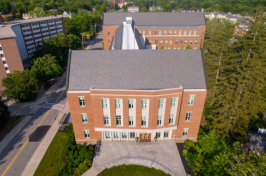
The conference will begin Thursday, Sept. 29, at 4 p.m. in Room
115 of Murkland Hall with a keynote address by David Sanger, White
House correspondent for the New York Times, titled “9/11
Plus Four Years: Does America Have a Strategy?” Sanger was
part of a team that won the Pulitzer Prize in 1987 for its investigation
of the Challenger Disaster. He went on to cover global economic
issues and foreign policy, as correspondent and bureau chief in
Tokyo for several years. He has been White House correspondent since
2000. Sanger’s address and all of the conference sessions
are free and open to the public.
The conference continues Friday, Sept. 30, in the Squamscott Room
of Holloway Commons with a full day of panels and discussions. Among
the leading scholars and journalists presenting remarks are Pulitzer
Prize winning Civil War historian Mark Neely; Tom Segev, a highly
regarded Israeli historian, journalist and author of The Seventh
Million: The Israelis and the Holocaust; and John Dinges, former
Latin American correspondent for the Washington Post and National
Public Radio. A complete schedule for Friday follows.
The Dunfey Endowment was established at UNH in 1993, to promote
discussion and study to reach understanding and resolution of world
and national problems. For more information, call UNH’s Department
of History at (603) 862-1764.
Thursday, Sept. 29 (Room 115, Murkland Hall)
4 p.m.
9/11 Plus Four Years: Does America Have a Strategy?: David Sanger,
White House correspondent for the New York Times
Friday, Sept. 30 (Squamscott Room of Holloway Commons)
9-10:30 a.m.
Lincoln and Civil Liberties in the Light of 9/11: Mark Neely, Pennsylvania
State University
Political Dissent, Terrorism, and Civil Liberties in Germany during
and after the Cold War: Mary Nolan, New York University
11 a.m.-12:30 p.m.
State, Terrorism, and Liberty in France from the Anarchists to Islamic
Jihad: Paul Jankowski, Brandeis University
The IRA and the War on Terror: Richard English, Queen’s University,
Belfast
2-3:30 p.m.
The Other 9/11: Pinochet, his Allies and a Decade of International
State Terrorism: John Dinges, Columbia University
Defining War and the Problem of Democratic Accountability in the
‘War’ on Terror: Mary Dudziak, University of Southern
California
4-5:30 p.m.
Living with Fear – Terrorism as an Everyday Experience: Tom
Segev, columnist for Ha’aretz, Israel
Democratic States and their Wicked Deals: Italy’s Role in
the Florescence of the Sicilian Mafia: Jane Schneider, City University
of New York Graduate Center
|