





















| |
 |
History Channel Fishes For
Modern Marvels Off New Hampshire Coast
Contact: Dolores Leonard
(603) 862-3685
CINEMAR
Dec. 15, 2004

DURHAM, N.H. -- To find the latest technology in deep sea aquaculture,
a film crew from the History Channel went fishing off the New Hampshire
coast last October. The University of New Hampshire’s Open
Ocean Aquaculture (OOA) project, and its research on lobster physiology
and behavior, will be featured on the network’s popular Modern
Marvels series Dec. 22, 2004 at 10 p.m. EST.
 |
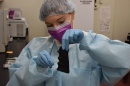
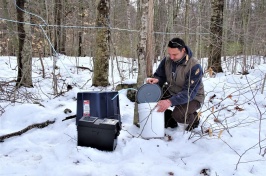
| Checking the feed buoy on a
winter day: Storms, high winds, and icy temperatures make the
regular feeding of fish in a deep sea farm a substantial engineering
challenge. UNH’s Open Ocean Aquaculture team has developed
a wireless communications system that facilitates fish observation
and feeding in any weather. |
“Modern Marvels: Commercial Fishing” will trace the
evolution of commercial fishing in the United States from colonial
times to the present. How do you design a fish cage that stands
up to New England’s notorious Nor’easters? How do you
feed fish swimming 80 feet below the surface without getting your
feet wet? How do you insure the practice is environmentally friendly
and economically viable?
The program will explore the innovative technology developed by
the OOA’s interdisciplinary team of researchers to answer
questions like these as they farm cod, haddock, halibut, and blue
mussels off the N.H. coast.
Lobsters also will be on the menu as the program presents techniques
such as Lobster TV, which offers a window on the aggressive behavior
of these feisty crustaceans. UNH researchers are using methods such
as these to provide information on how to better manage New England’s
lobster fishery, an integral part of the region’s cultural
heritage and economy.
UNH’s Open Ocean Aquaculture project is part of CINEMAR, the
Cooperative Institute for New England Mariculture and Fisheries.
A joint institute between UNH and the National Oceanic and Atmospheric
Administration (NOAA), CINEMAR provides regional leadership and
integration for research, development, education, and outreach to
support the use, management, and preservation of New England fisheries. |