




















| |
 |
UNH Honors Teacher for Work
in Forest Watch Program
Contact: David Sims
603-862-5369
Science Writer
Institute for the Study of Earth, Oceans, and Space
Dec. 1, 2003

DURHAM, N.H. – Elementary school teacher Bob Dyer of the Shapleigh
(Maine) Memorial School has been awarded the 2003 Gary N. Lauten
Award for outstanding service and commitment to the University of
New Hampshire’s Forest Watch program.
“This award is presented to the Forest Watch teacher who most
exemplifies Gary’s love of the program and his devotion to
the program’s long-term goals,” said Barry Rock, Forest
Watch director and professor of natural resources and plant biology
at UNH’s Institute for the Study of Earth, Oceans, and Space
(EOS).
 |
| Left to right: Mike Gagon,
Forest Watch program coordinator; Barry Rock, Forest Watch program
director; Bob Dyer, Lauten Award recipient; and Darien Lauten,
Gary Lauten's widow. |
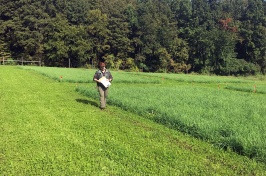
Forest Watch is an educational outreach program that gets primary
and secondary students directly involved in the collection and processing
of data about air pollution damage in white pine forest stands.
The program conveys the excitement and importance of hands-on science
and the value of understanding the impacts of environmental factors
on forested ecosystems to K-12 students across New England.
Lauten, who received a master’s degree in plant biology from
UNH after retiring from the Air Force as a lieutenant colonel, became
a UNH research scientist and was involved in the development and
continuation of Forest Watch. He served as the program’s coordinator
from 1992-1999. He died in December of 2001. "This award recognizes
Gary's commitment to making science accessible in the classroom.
He loved the program and became its heart and soul, said Rock"
Dyer, a long-time Forest Watch teacher, is the second recipient
of the Lauten award. Rock presented Dyer with a certificate and
a handcrafted walking stick bearing the Forest Watch logo. Of the
gift Rock said, “This is very appropriate because I leaned
on Gary a lot.”
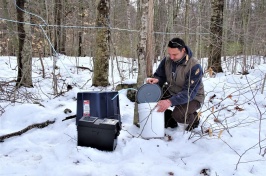
Like other teachers involved in the program, Dyer has his students
collect white pine needles from a 30 x 30 meter plot each year.
They then conduct several ecological and biophysical measurements
using specific scientific protocols developed at UNH. The samples
are measured and analyzed physically by the students who look for
evidence of damage to the needles from ozone (smog).
Their results, as well as needle samples, are shipped to UNH for
further analysis. The program has demonstrated that students can
collect valuable data for ongoing scientific research and learn
science and mathematics by doing research in their local area.
“This allows kids to get physically involved in doing real
science, from field sampling and analysis to seeing their data up
on the Internet,” Dyer said.
Forest Watch, which is funded by the New Hampshire Space Grant Consortium,
currently includes more than 200 schools and study plots across
New England, and allows UNH to conduct a regional analysis of white
pine health.
Student data are compared to spectrometer measurements (which gauge
how much chlorophyll needles contain) collected from samples sent
to UNH, and the student and spectral data are compared to tropospheric
ozone data collected from state and Environmental Protection Agency
(EPA) air quality monitoring sites throughout New England. Student
samples provide evidence of changing white pine health and growth
year after year in response to both smog levels and climate variables
such as rainfall.
For more information on Forest Watch, go to www.forestwatch.sr.unh.edu.
A digital photo is available at the Web site: http://unhinfo.unh.edu/news/img/eos/lautenaward.jpg
Photo Caption: Left to right: Mike Gagon, Forest Watch program coordinator;
Barry Rock, Forest Watch program director; Bob Dyer, Lauten Award
recipient; and Darien Lauten, Gary Lauten's widow.
|