























| |
 |
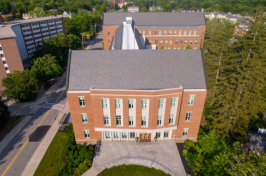
UNH's Chemical-Free Residence
Hall is the Top Place To Live
Engelhardt Hall is One of Several Popular Themed Halls on Campus
Contact: Lori Gula
603-862-0574
UNH Media Relations
Aug. 25, 2003

DURHAM, N.H. – When University of New Hampshire
students move back into their residence halls beginning Saturday,
Aug. 30,
130 undergraduates who want to live a chemical-free life – no
alcohol, tobacco or drugs – will move into Engelhardt Hall
as part of a themed living community on campus.
The chemical-free themed living community is the most popular of
UNH’s 16 themed living communities at its residence halls.
Engelhardt Hall has had student return rate of 60 to 75 percent
in recent years, and last year had a waiting list of students wanting
to live in the community. This fall, 44 of the 45 first-year students
who will live in Engelhardt Hall specifically requested the chemical-free
environment.
“Engelhardt is a great place to live. It develops a good
sense of community and friendship,” says Mark Santos, a sophomore
from Chester, who spent his first year in Engelhardt Hall.
Created by the UNH Department of Residential Life, themed living
communities in residence halls allow students with common interests
to live together and establish friendships. Often, providing these
niche communities for students helps smooth the college transition
process.
According to Englehardt Hall Director Patrick Wade, students enjoy
living in Engelhardt because it is chemical free, traditionally
quieter than most halls, and fosters an environment in which everyone
feels accepted. “As a result, the sense of community in Engelhardt
is very strong, with lots of well-attended programs sponsored by
resident assistants and the hall council. Most importantly, students
find Engelhardt very academic friendly, as proven by the community’s
consistently strong grade point average,” Wade says.
Student interest in the chemical-free theme is indicative of the
increasing demand for themed living communities. In just three
years, the number of themed communities has doubled, from eight
in 2000 to 16 this fall.
“Experts agree that first-year students face transition issues
that can impede or enhance their college experience," says
Kristin Carpenter, assistant director of Residential Life. "One
transition issue common to most students is the developmental need
to feel
connected. With a supporting structure in place, a student is more
likely to feel connected to UNH, their classes and their new life
away from home.”
Results from the annual Residential Life Survey indicate the themed
living communities are a success with students. At Eaton House,
home to the Creative and Performing Arts themed community, 94 percent
of residents reported experiencing a meaningful individual connection
with a faculty member. The campus average is 41 percent. At the
Science and Engineering community at Sackett House, 67 percent
of residents said they participated in an informal study group
in the fall 2002 semester. The campus average is 47 percent.
Several themed living communities unite students based on major.
New this fall is The Clubhouse in Gibbs Hall, designed for students
interested in sports or recreation. Living in Harmony in Devine
Hall had a successful first year bringing together UNH’s
undergraduate music majors and students interested in music. “It’s
fun to live near people who love and appreciate music in every
aspect just as much as you do; it’s truly a unique and dynamic
floor,” says Anne Pella, a sophomore from Pelham, who spent
her first year in Living in Harmony.
Other halls bring together students with common interest and life
experiences.
International students enjoy the International Living themed community
in Smith Hall, which is home to 92 students.
Approximately one third of residents are international students
while the rest have lived/studied abroad, or are interested in
international living. “I have loved living in Smith this
year because I have never before met so many interesting and admirable
people,” says Kayla Warren, a sophomore from Falmouth, Maine,
who spent her first year in Smith Hall.
For students interested in community service, Richardson House
offers the Community Service and Involvement themed community that
allows residents to develop connections with the local community
through service projects. Christensen and Williamson halls provide
first-year students their own themed communities. These freshman
residence halls provide additional resources, such as WildCat Mentors
and an Academic Help Desk. For a complete listing of UNH’s
Themed Living Communities, visit www.unh.edu/residential-life/sih.html.
-30-
|