


















UNH Eye-Spy:
Scientists and Students Building Machines That Can 'See'
By
Sharon Keeler
UNH News Bureau
DURHAM, N.H. -- Machines that see could soon help police investigate crime scenes or doctors examine cells for signs of disease.
Sound like science fiction? It isn't. At the University of New Hampshire's
Synthetic Vision and Pattern Analysis Lab, professors and students are
already working on these and other cutting-edge technologies.
"Synthetic vision, or machine vision, creates a system that mimics how
humans see and perceive data," says lab director Richard Messner, associate
professor of electrical and computer engineering. The human eye takes
light reflected off an object and focuses that light onto the retina.
Photoreceptor cells transfer the image into electrochemical impulses that
are sent to the brain, where "seeing" occurs. Similarly, synthetic vision
involves using machines and computers to acquire images, digitize and
compress the data into electrical signals, transmit those signals to a
processor, and then reconstruct the image.
Synthetic vision and pattern analysis research has enabled the development
of now-common office fixtures like the photocopier, FAX machine and scanner,
as well as medical tests like the CAT scan and MRI. The technology involved
is mind-boggling.
"Take this computer component," says Messner, fingering a gizmo half
the size of a business card. "It's used to power a machine that allows
doctors to see inside arteries during cardiac catheterization. It performs
about 30 million computations per second to provide real-time processed
images from inside the body, which makes it possible for the doctor to
perform this procedure."
Synthetic vision engineering requires the compression of huge amounts
of information before it can be transmitted. Messner is researching new
compression schemes that will have implications for all types of technologies.
As an example, he cites the ability to broadcast real-time video images
over the Web with greater clarity.
"The Web uses what's called bandwidth to carry information," says Messner.
"It's like a pipe. To increase the water flow, you can increase the diameter
of the pipe or the speed -- the pressure -- at which the water flows.
I'm working on both challenges."
Messner's students are using the same cutting-edge technologies. Senior
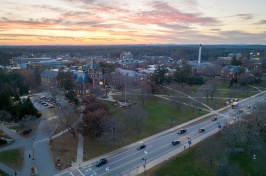
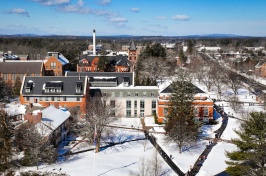
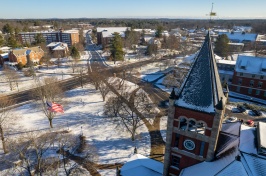
Richard Lynch built a camera last semester that now broadcasts real-time
campus images over the Web. He designed the machine, built it, and wrote
the computer code that makes it operational. People with Web access can
go to http://svpal1.unh.edu/skycam
and, with the click of their mouse, "point" the camera in almost an direction
and zoom in or out for live campus video.
UNH graduate Tony Pawlak, another student of Messner, laid the groundwork
for a machine that takes video images of cells and processes the image
data for doctors to review. His work involved categorizing cells that
indicate Huntington's disease. According to Messner, the "beauty" of the
system, once it's complete, is that different computer programs can be
used to help doctors distinguish various genetic diseases.
Messner is also developing advanced technologies for law enforcement
with colleague Tom Miller, professor of electrical and computer engineering.
The project is funded by a $2 million grant from the U.S. Department of
Justice. He will lend his expertise in developing such devices as fingerprint
scanners and real-time surveillance cameras.
It's hard to imagine life today without machines that can "see," -- and
harder still to imagine what lies ahead. Retina scans instead of passwords,
video phones in every household, 3-D photographs. All are possible --
and could very well be the result of work done at UNH.
June 12, 2000
Back to unh.edu.
|