
























|

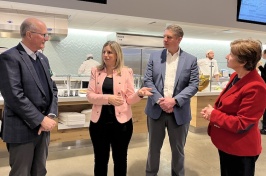
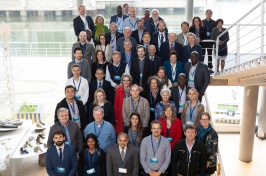
Ezster Kiss
(front, second from left), a coordinator in the Study Abroad Office
at BUTE, and CEPS Educational Assistant Carol French (front, third
from left) with 2003 UNH/Budapest Exchange participants. (Courtesy
photo.)
CEPS
Students Find Budapest Program
A Life-changing Experience
By
Robert Emro, CEPS
Participants in the UNH/Budapest academic exchange program make
one thing abundantly clear: some of the most important lessons young
college students can learn happen outside the classroom –
especially when the classroom is outside the country.
Participants in last fall’s program recently reunited to talk
to more than two dozen interested students and their parents. These
College of Engineering and Physical Sciences (CEPS) students brought
home much more than the academic knowledge gained from their semester
at the Budapest University of Technology and Economics (BUTE).
CEPS Dean Arthur Greenberg, on hand to meet prospective participants
and their parents, himself spent six months studying at the University
of Liege in Belgium before going on to graduate school. “When
you come back from living in a foreign country on your own, you
learn a lot of life skills – it opens up a different perspective,”
he said. “It truly is a life-changing experience.”
With a 200-year tradition of excellence in engineering education,
BUTE boasts five Nobel laureates in physics, chemistry and economics
and is an important research center. Studying at one of Central
Europe’s top universities had other benefits as well.
Living in the heart of Europe, all of the students were able to
experience not just Budapest, but many of the storied cities of
surrounding countries as well. Their exposure to so many different
cultures presented opportunities for personal growth they could
never have found in Durham.
“It really opened up the world for me, because I’m from
Maine and I’ve never been anywhere,” said Rebekah Briggs,
a junior in civil engineering. “To go to Prague, Vienna, Venice,
Krakow, Bucharest, that was awesome.”
With its hilltop castles, magnificent architecture and the Danube
River, Budapest made a positive impression on these students. “Budapest
is the perfect city to study abroad in,” said Alexander Unrein,
a junior in mechanical engineering. “The feel of it is not
quite so touristy, unlike Venice or Prague, and it’s very
affordable. You can live off of $2,500, and that includes everything.”
These students, like most who participate in the program, went in
the fall semester of their junior year and paid about the same price
as a semester at UNH. They avoided lost time toward graduation by
taking courses they would normally study in their fall semester.
UNH advisors review the courses before hand to assure that credits
will be fully transferable.
While the classes in engineering, math and the physical sciences
are taught in English, the UNH students do have to adjust to a different
teaching style in Budapest – one that did not require any
homework or projects. “All our grades were based on our final
exam,” explained Briggs. “We really had to become responsible
for our own education.”
Much of the rest of their daily life – from negotiating with
landlords to ordering a bowl of goulash – occurred in Hungarian,
or Italian, or Czech, or German, depending on where they happened
to be.
This could at times make things difficult, said the students, but
they learned that adversity is not always a bad thing.
“Having the language barrier was definitely a challenge,”
said Alyssa Rezendes, a junior in civil engineering. “It did
help us grow, because you learned to communicate with people —
and to have patience.”
For more information on the UNH/Budapest Exchange program, CEPS
students can contact Carol French at 862-1783 or carol.french@unh.edu,
or Marina Markot at 2-2366 or marina.markot@unh.edu.
|