






















| 
Showing Their Muscle For Mussels
Jackson Lab and fourth-graders team
up for restoration project
By
John Reed, UNH Media Relations
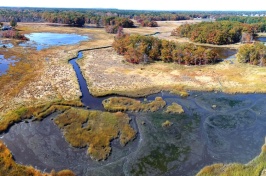
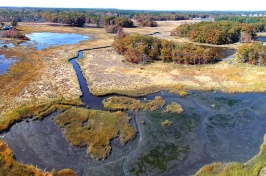
In the midst of 32 fourth-graders wading through the mud of Portsmouth’s
North Mill Pond is UNH ecologist David Burdick telling the students,
“Make sure they’re not upside down, they won’t
be able to attach themselves to the grass. Don’t fall in.”
He’s talking about the approximately 900 ribbed mussels being
planted by the students as part of a UNH Jackson Estuarine Lab cosponsored
saltwater marsh restoration project recently.
For seven years Burdick has worked with the nonprofit group, Advocates
for North Mill Pond, and the New Franklin Elementary School in Portsmouth
to introduce mussels to the pond’s smooth cordgrass marsh.
The project started after a 1997 Jackson Estuarine Lab study found
that there were no animals present in the marsh which had been artificially
created to make up for marshland lost to the NH Port Authority expansion.
In 1998, Burdick teamed up with now retired New Franklin Elementary
teacher Ann Smith, whom he had met while working with the Advocates
for North Mill Pond. Together the two formed the program through
which the fourth-graders plant the mussels in the pond.
“Ann expressed interest in her class contributing to the habitat
restoration I was involved with in the pond. I had just finished
advising a project with an undergraduate who examined the potential
to re-establish ribbed mussels in the pond. Sounds obvious in retrospect,”
Burdick said.
In addition to planting the mussels the students have taken water
samples from the pond and learned of its cultural and historical
ties to Portsmouth.
Over the years, the fourth-graders have planted approximately 5,000
mussels.
Ecologists chose the ribbed mussels as the first species of animal
to introduce to the marsh because of the important role they play
in maintaining a healthy marsh ecosystem.
The mussels clean the water coming into the marsh by filtering bacteria,
sediments and phytoplankton out of the water.
At the same time their waste helps to fertilize the marsh plants.
The mussels also serve as food for other marsh animals that are
higher on the food chain.
In addition to helping the marsh develop a healthy ecosystem, the
project gives the fourth-graders a chance to learn about giving
back to their community in a fun way. “Adding ribbed mussels
is something fourth graders can do to make a positive impact on
the pond ecosystem,” Burdick said.
With each student required to plant 30 mussels, there was plenty
of time for students to have fun with the project. “It was
fun. I planted a real small one. They’re really slippery sometimes,”
said Chris Casey, 10.
The mussel planting is scheduled to continue for one more year when
the total mussel population in the marsh reaches 6,000. After that,
Burdick says the mussel population will have hopefully reached a
level large enough to sustain itself.
In addition to Jackson Estuarine Lab, the marsh restoration project
is cosponsored by the Advocates for North Mill Pond, the Portsmouth
School System, and Great Bay Coast Watch.
|