
























A mentoring program that has assisted hundreds of middle school students in the Durham area since 1997 will be expanding statewide this fall through a partnership with USNH and its four institutions. Project Mentor, a program that pairs sixth-graders with college students for three years, began recruiting student mentors from its institutions this month through a series of events at UNH, UNHM, Plymouth State University, Keene State College, and Granite State College.
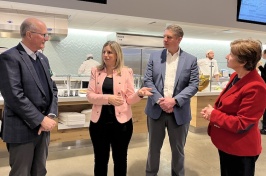
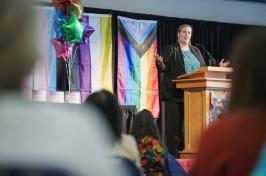
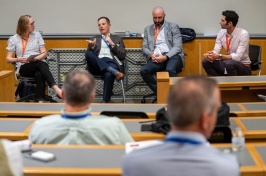
The expansion of Project Mentor was formally launched March
6 during the first recruiting event at UNHM and featured Gov.
John Lynch, USNH Chancellor Stephen Reno, and Department of Education
Commissioner Lyonel Tracy. Last year, Lynch asked the USNH
Board of Trustees to consider ways through which public higher
education could assist him in developing ways to address New
Hampshire’s high school drop out rate. The trustees
and Reno decided to replicate the Project Mentor across the state,
believing that this program could provide some key support to
middle school students to encourage them to stay in school and
prepare for and enroll in college.
The program’s unique approach of training mentors through
classroom instruction and support in the schools have helped
the mentors impact the lives of more than 500 middle school
students over the history of the program. Through this expansion,
the number of students served per year will double, to a minimum
of 160.
“It is critical from a social, educational, and economic standpoint
to do whatever we can to break down real and perceived barriers
our young people may have in terms of finishing high school
and going to college,” said Andrew Lietz, the chair of
the USNH Board of Trustees. “Our Board believes
that an expanded Project Mentor is the best single way we can
make an impact, and students and staff at our institutions
are eager to participate and serve more of our youth during
these crucial years of development.”
As a mentoring network, Project Mentor would recruit, train, and support undergraduate students all USNH institutions to serve as mentors for middle school students across the state. Building outward into the communities immediately surrounding the USNH campuses and learning centers, these programs would pair undergraduate college students with incoming sixth-grade students (to continue through to the end of eighth grade) to help them navigate some of the challenges of adolescence, strengthen academic performance, and raise aspirations for college. Male college students are paired with boys and female college students are paired with girls. All mentors go through a background check and parental approval is required for the mentees.
UNH Project Mentor director and founder, Barbara Krysiak, professsor of education, is leading the expansion effort and is working with program coordinators at each site to plan recruiting events in March and April. Krysiak, a former superintendent who spent nearly four decades working in K-12, has committed her career to encouraging students to complete high school and to using mentoring as a tool to help with this process.
“Children at this age need as many adult supports they can get. The students who work through Project Mentor become roles models for these kids, take an interest in them, and create a connection that often continues beyond the mentoring experience,” Krysiak said.
The USNH Office of Research and Planning will provide support for this effort and measure the impact of the project over a three-year period. The expanded program will be fully operational in at least four new regions for the fall 2006 school year. Anyone interested in learning more can contact Barbara Krysiak at 2-1127.