
















Archive Letters Forum Higher LearningSearchPublishing ScheduleContact Us


Winter 2006 Parenthesis: UNH's Land-Grant Status

UNH is one of more than 100 colleges and universities that comprise the nation’s Land-Grant University System. Here, Bill Trumble, dean of the College of Life Sciences and Agriculture, provides an overview of this system, and talks about what it means for UNH students.

Q. How did the Land-Grant system begin and what does it mean to be a land-grant school?

In 1862, Congress passed a bill submitted by Vermont congressman Justin Morrill, setting the stage for the Land-Grant system. The action granted each state 30,000-acre parcels multiplied by the number of House and Senate members for the state. The states were to use the money from that land to create colleges emphasizing the teaching of agriculture and engineering (the mechanical arts). These schools became know as the Land-Grant colleges. Later, Congress passed bills creating a partnership between the U.S. Department of Agriculture and the Land-Grant colleges, where the USDA provided base funding to each Land-Grant college if the state matched the funds on a dollar-for-dollar basis.

Because in the mid-1800s college was expensive, a privilege of the wealthy, the creation of these Land-Grant colleges intended to provide education and research to serve the “common people,” state needs, and the problems of the region. This is still the philosophy of the Land-Grant system today.

Q. How does the Land-Grant philosophy apply to the twenty-first century?

Although the practices of agriculture and natural resource management have changed enormously over the last 150 years, the need for education and information has not. Having access to healthy, nutritious food and having the ability to respond to new or recurring crises or problems remain relevant concerns to all citizens. The Land-Grant University system has two components that are as active today as ever: the Agricultural Experiment Stations (AES) and Cooperative Extension. Though managed independently, these entities are two sides of the same coin. The AES creates knowledge and technology to solve problems, while the Cooperative Extension carries information and assistance to the people of the state.

Since I direct the AES, let me share what that organization does. There are five national concerns that all stations seek to address:

1. A highly competitive agricultural system in a global market.
2. A safe and secure food and fiber system.
3. A healthy, well-nourished population.
4. An agricultural system that protects natural resources and the environment.
5. Enhanced economic opportunity and quality of life for Americans.

Specifically, the AES promotes and funds research, within its mission, to address these concerns and to solve problems for citizens in the state and region.

Q. How does the Land-Grant status make a difference in today’s student experience?

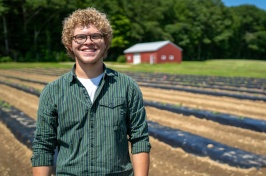
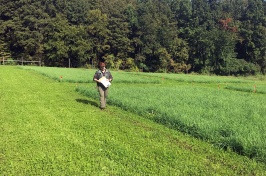
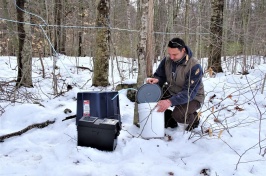
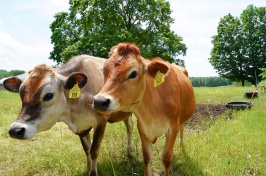
Once again, I’ll focus on the AES (one of the components in the Land-Grant System) to address the student experience. In very broad terms, the AES controls about $6.5 million dollars. Nearly half of that amount is used to pay a portion of salary for faculty conducting research projects. This support allows the University to have more and better faculty than would be possible without that assistance. These faculty also teach and provide great expertise to the curriculum. About 15 percent of our funds are used to support graduate students as research assistants. This offers support to graduate students as they are trained to conduct research and provides help to the faculty for their research efforts. Another 15 percent of our funds maintain our farms and outdoor teaching laboratories, allowing “hands-on” education for students. Since the College of Life Sciences and Agriculture strongly encourages experiential learning, we seek to offer to our students the opportunity to work with faculty; in a research lab, with animals and crops on our farms, and in the environment (mountains, forests, lakes, and ocean) exploring our natural resources. Approximately 11 percent of the AES funds support faculty and student research projects. This support is highly discretionary for the faculty and their students and provides supplies, equipment, travel money for conferences to share data, and the preparation of scientific manuscripts. The remaining funds cover administrative costs and pays assessment to the University. In total, these funds give students greater access to faculty, research support, farms, greenhouses, and other outdoor laboratories; partially fund a large number of graduate students; and add a valuable “hands-on” component to classroom education.

Q. What are the recent challenges to the Land-Grant system?

As many folks know, last year when the Bush administration submitted the President’s budget, funding from the USDA to the AESs was to be eliminated completely over two years. Had this budget been adopted, the loss of funding to UNH would have been of such a magnitude that we would have lost 30 faculty members, lost support for 35 graduate students, and closed all the farms (thus losing a number of living laboratories for students). We prevailed in encouraging Congress to restore the funding for the AES in the budget for next year, but were told to expect the funding will be challenged again next year as Congress continues to seek cuts in spending from a number of sources. In my opinion, this would be a shortsighted attempt to demonstrate financial responsibility, given that every Federal dollar the AES receives is leveraged to bring in ten additional dollars.

Another challenge will be to remain relevant to agriculture, which is rapidly changing in the state and New England. This challenge will demand research and education in new areas. Local and organic food, as well as value-added products will be important. Horticulture is now the fastest growing industry in the state. Timber products and tourism both are areas where more University expertise is needed. For the AES to remain relevant to these areas, and others, the University and the AES need to change with the times. To address these issues, much of our research support is directed to faculty-led team efforts targeting specific needs or problems. It is a changing world and we are changing along with it, but I think we’ll have a tough “row to hoe” trying to stay ahead of the needs. UNH has an exceptional faculty; I have every confidence it will get done.


Submit your FYIs to campus.journal@
unh.edu
.