






























By Jody Record, Media Relations
Kristin Harris uses geography to explain the thinking behind developing an internship program for high school students at UNH’s InterOperability Laboratory, where workers test communication products for the networking industry.
“We have companies in Japan who use us but people around the block don’t know we’re here,” says Harris, the customer relations coordinator for IOL who, this summer, also headed up their first introduction for high schoolers. “We may not be MIT but we are a local powerhouse.”
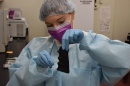
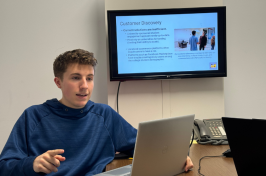
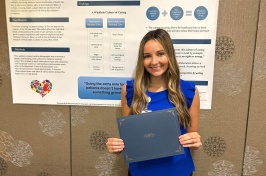
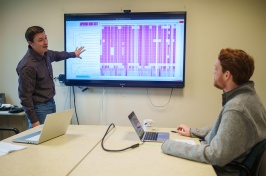
Manchester Central High School senior Kaley Smith explains the project she worked on during her seven-week internship at the InterOperability Laboratory to IOL’s Chris Volpe.
Here’s what backs that up: for the past 16 years, IOL has been conducting tests on the equipment made by just about all the big name players in the business--Microsoft, Apple, Dell, Intel, Sony, Texas Instruments, for example—as well as for a field of lesser-knowns. The companies pay an average of $15,000 for a year’s worth of testing. Additionally, they are required to dedicate a piece of equipment to IOL’s test beds—an internal network of all the products under scrutiny.
IOL employs about 100 UNH graduate and undergraduate students plus a full-time staff of 20. The idea to create a paid internship for younger students came when Harris was looking at ways to let Granite State high schools know what’s going on at the Technology Drive lab. Initially there had been talk of bringing in guidance councilors for a tour of the site but further discussions led to launching the seven-week program instead.
“Students are so important to us that we decided to go right to them and start the pipeline a little bit earlier,” Harris says.
Thirty-eight incoming high school seniors submitted applications. Seven were selected, based on a 500-word essay describing why they were interested in computer science, their GPA, two recommendations, and an interview.
“Not everyone we chose had computer science experience,’’ Harris says. “We were looking for motivated candidates.”
After spending one week each in the computer science and electrical engineering departments, the students were assigned a manager and a project. Then they started doing the two forms of testing the UNH students run, checking hardware to see if it is in conformance with international engineering standards and making sure each implementation works with every other one.
“If it doesn’t, we find out why and we solve the
problem,” says IOL’s Chris Volpe.
The laboratory’s role, says Volpe, is to provide a neutral
ground for competing companies to test their wares against
each other.
“This gave students the chance to get their feet wet in network testing,” Volpe says. “At the same time, we’re helping UNH provide experiential learning and preparing UNH students for careers in the industry. We see the intern program as a way to extend into the community. ”
When IOL was founded in1988, one of its first areas of focus was the Internet and, over time, Volpe says, UNH became a “de facto test house.” As such, there are plans to expand the summer internship. Harris would like to branch out to other high schools in New England, perhaps providing housing and meals as payment instead of cold cash.
“Our goal was to increase the academic development of these students and enhance their experience while increasing awareness about UNH and IOL in the New Hampshire community,” Harris says. “I’d say we were successful.”
They were according to Manchester Central senior Kaley Smith, one of the interns who arrived at IOL without any computer science classes under her belt.
“It made me realize how much I didn’t know,” Smith says. “It was a really helpful experience and it’s definitely made me lean more toward UNH.”
If she does decide to attend UNH and wants a job, she won’t have to look very far.
“All of the students have been offered jobs here at IOL,” Harris
says. “Those who don’t elect to come to UNH will
likely pass our name along to their peers. For the interns, they’re
going to get tangible, real world experience. And IOL will help
develop engineers locally.”