
















`


CIE Travel Report: Carolyn White

Carolyn White, associate professor of library science, UNHM Library and Media Services, received one of the 2006-07 CIE Faculty International Travel grants funded by the VPAA. White recently traveled to Prato, Italy, to present a paper at the 6th International Conference on Knowledge, Culture, & Change in Organisations. Below is her report.

Carolyn White at Prato Fountain

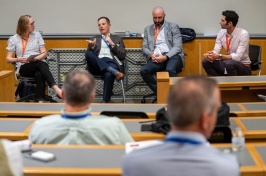
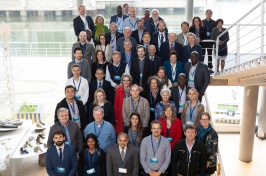
In July I attended the 6th International Conference on Knowledge, Culture, & Change in Organisations at Monash University Centre in Prato, Tuscany, Italy. The conference focused on the ways in which new methods of information storage and delivery are transforming organizations, as well as how businesses and educational institutions must change to meet the requirements of the “knowledge economy.” My colleague Dr. Susanne Paterson (UNH Manchester English Department) and I presented a paper entitled “From Information to Knowledge: Transforming Library Instruction for the Digital Age.” The conference was the ideal venue for a discussion of our research into library instruction and student learning as it afforded us the opportunity to share our work in the area of information literacy with a wide, international audience of educators and business professionals.

“Information literacy” is a movement in library instruction that stresses critical thinking skills, transferable knowledge, and lifelong learning as the ultimate pedagogical goals of student research. To be truly information literate, students must learn not only how to find information, but how to evaluate, analyze, synthesize, and use that information in the creation of new knowledge. Dr. Paterson and I have worked together to introduce active learning strategies and evaluative exercises into the library instruction sessions for her literature courses, and last fall we collaborated to design a Freshman Composition research assignment and corresponding research instruction class that focused on the evaluation of sources. Such critical engagement with information is essential in the ever-changing technological landscape students will encounter as they enter the workforce. Our paper described the assignment and the library instruction sessions, and demonstrated that information literacy prepares students for the “information age” by giving them the habits of mind they’ll need to adapt to the changing demands of a knowledge-based society. We also argued that for students to leave the university as information literate citizens, various campus constituencies—librarians, teaching faculty, writing center staff, and administration-- must cooperate to weave information literacy objectives into the curriculum.

It was a truly gratifying experience to share ideas with educators from around the world, receive their feedback on the project, and talk with them about their own experiences with student research instruction. I attended other paper presentations on information literacy and educational technology and learned new pedagogical methods that I can incorporate into my teaching repertoire. I was also inspired by the ways that educators at other institutions--in universities as far afield as Canada, the UK, and Australia-- are collaborating across disciplinary boundaries in an effort to best meet students’ educational needs. As a result of our participation in the conference and the constructive comments we received, Dr. Paterson and I plan to turn our presentation into an article and submit it for publication in the conference’s proceedings journal, the International Journal of Knowledge, Culture, and Change Management.


Submit your FYIs to campus.journal@
unh.edu
.