























Richard England, professor of economics and natural resources, received one of the 2006-07 CIE Faculty International Travel grants funded by the VPAA. England recently returned from Kyoto, Japan, where he participated in the Third World Conference of Environmental and Resource Economists. Below is his report of his trip.
This was my first trip to Asia, and it was a truly memorable experience. After a long flight from Boston to Osaka via Chicago, I arrived bleary-eyed and was pleased to find a white-gloved shuttle driver waiting to transport me to Kyoto, the former capital of Japan. Kyoto is a densely populated city of 1.5 million ringed by forested hills. Buddhist temples, Shinto shrines and imperial palaces from premodern times coexist with contemporary department stores, condo projects and industrial plants.
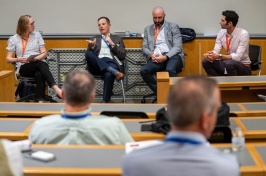
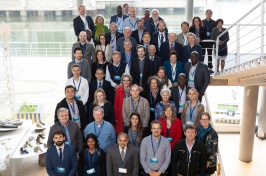
The global congress at which I presented a scholarly paper on gasoline taxation and energy conservation took place in an ultramodern conference center on the leafy northern fringe of Kyoto. The choice of this Japanese city for an international meeting of environmental economists was hardly an accident: The Kyoto Protocol, a treaty to control emissions of greenhouse gases into the atmosphere, has not yet been implemented. The nations of the world still have to adopt policies to contain global climate change and the conference organizers wanted to accent that imperative.
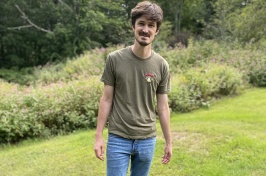
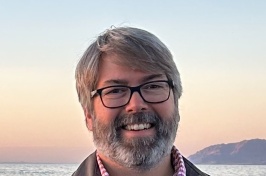
Richard England enjoys a moment in Japan with a group of students.
Experiencing Japanese society for a few days was just as exciting for me as my attendance at the environmental conference. Over and over again, I was struck by the friendliness and generosity of the Japanese I encountered. (On one occasion when I was hopelessly lost inside the mammoth central train station, two young policemen offered to walk me through the entire station and out the back door to my destination.)
Despite the city’s high population density, its streets are not hopelessly clogged with motor vehicles. The apparent reason is that many residents of Kyoto still walk, ride bicycles or use the city’s immaculate and convenient public transit system to get around.
Although Japan’s population is aging rapidly, I was struck by the number of children and teens traveling the city’s streets, usually in single-gender groups and without adult supervision. In contrast with the United States, where many people fear street criminals and sexual predators, the parents of Kyoto apparently trust in the safety of their public spaces.