

















Archive Letters Forum Higher LearningSearchPublishing ScheduleContact Us


Two academic deans: UNH Manchester and CEPS 

By Lori Wright, Media Relations

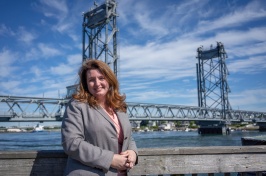
The 2004-2005 academic year has brought transition for two key academic areas at UNH: UNH Manchester and the College of Engineering and Physical Sciences. Karol LaCroix, former dean of UNH Manchester, was named president of the College for Lifelong Learning and assumed her new role Aug. 1, 2004. Arthur Greenberg, dean of CEPS, decided to return to the CEPS faculty.

“Karol's eight years of service as dean at UNH Manchester were stunningly successful. She brought together separate physical facilities into a single, integrated learning environment, located in a renovated mill building. She made the city her closest partner for educational, service, and cultural resources, and the city in turn developed a great pride in the Manchester campus. She built a strong sense of community among staff and faculty, and she mentored student leaders who established a strong student government organization,” Provost Bruce Mallory said.

“Art Greenberg has worked tirelessly on behalf of the students, staff, and faculty of CEPS. He brought a broad vision of the sciences, engineering, and technology to his role as dean when he was appointed five years ago, a vision that emphasized the relationship between these fields and the liberal arts. His close collaborations with his fellow deans have led to new undergraduate and graduate programs as well as new areas of research that reflect the social challenges of medical diagnosis, homeland security, environmental monitoring and protection, and complex geosystems,” Mallory said.

Dean of UNHM
According to LaCroix, her greatest challenges and accomplishments during her tenure at UNHM dealt with facilities, academic programs and finances.

“When I first arrived at UNHM, the college owned property at Hackett Hill and leased space in the downtown mill yard. Through negotiations with the city, we were able to sell the Hackett Hill property, and purchase and renovate the downtown mill known as University Center where the college is now located,” LaCroix said.

Under LaCroix’s leadership, UNHM established its first endowment and developed new programs specific only to UNHM that better met the needs of the students and more fully reflected the urban environment and the resources it had to offer. The college also instituted the Summer ESOL program and added graduate programs, creating the UNH Graduate Center.

“By the time I left UNHM, it had realized its goal of becoming an urban institution, which by definition integrates its teaching, research and service with the resources of the Manchester community. The city, in turn, recognized that the university was and is a valuable entity that contributes to the economy and improves the quality of life for the people of Manchester,” LaCroix said.

In the next five to ten years, LaCroix said UNHM will face greater competition for qualified students. “The college will need to examine how and when it offers its courses, whether the traditional semester is the best delivery system when adults and high school students living at home are looking to complete their degrees in a timely manner,” she said.

She urges UNHM to consider expanding to other locations, and consider a partnership with CLL. Finances and facilities will continue to be issues, but she said she is “confident that the college can meet these challenges with its outstanding faculty, dedicated staff, strong community ties along with the quality leadership and support from the president and provost.”

“Her commitment to access for working class and first-generation students, her willingness to be the public face of the campus throughout the region, and her boundless optimism will always be remembered. These same traits are already serving her well in her new role as president of the College for Lifelong Learning,” Mallory said.

Dean of CEPS
According to Mallory, Greenberg’s contributions have been numerous.
He led the academic planning and space allocation decisions for the largest, most complex building project in UNH history – Kingsbury Hall -- which is now on schedule, with the first phase to open at the end of 2005.

Greenberg worked with faculty to reduce the first to second year attrition rate, and has put in place new curricula in math, physics, and chemistry to attract new majors and increase their retention. He developed new collaborations with industry in NH and the region, with an emphasis on research and design of new technologies and advanced professional development for engineers and scientists.

CEPS developed new collaborations with College of Life Sciences and Agriculture (COLSA) and the Whittemore School of Business and Economics (WSBE) in areas of biotechnology, homeland security, project management, and environmental sciences. The college also fostered new connections with schools and public school students, through supported competitions such as For Inspiration and Recognition of Science and Technology (FIRST), through new CEPS relationship to Project SMART (Science and Mathematics Achievement through Research Training), and through his support of the development of the Leitzel Center.

Greenberg has worked to increase participation of women in sciences and engineering, both as students and as faculty, and has fostered new international partnerships in El Salvador and Egypt.

“Art's contributions are many. He is appreciated especially for his humane values, strong academic standards, and commitment to UNH's public mission. I wish him the best as he returns to the classroom and his lab,” Mallory said.

Greenberg said one of his my greatest accomplishments as dean was working collaboratively to make the new Kingsbury Hall a reality. “It’s going to be a beautiful 21st century building. We have also laid the groundwork for the three other major CEPS buildings: DeMerritt, James (with COLSA) and Parsons. This has helped to place the engineering programs in a solid position for the 2005 accreditation visit,” he said.

Going forward, Greenberg said funding will continue to be an issue for CEPS. He suggested CEPS continue to look for ways to partner with other colleges. “It will be important to the university as a whole, if it continues to face increased financial pressure, to continue to foster collaboration and (only) healthy competition between the colleges: that’s going to be a challenge in a challenging financial environment,” he said.

UNH has concluded its searches for the two positions. The new dean of UNHM is Kristin Woolever (see related story), and the new dean of CEPS is expected to be announced soon.


Submit your FYIs to campus.journal@
unh.edu
.