




















| 
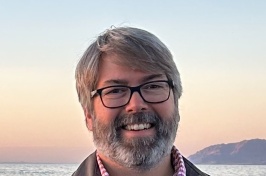
Rick
Cote’s aerobics class at the UNH Rec Center has been one of
the most popular classes for several years. (Katelyn Dolan/Media
Relations)
From Proteins to Push-ups
The Energetic Life of Professor Rick Cote
By
John Reed, Media Relations
Amidst the sounds of high-tempo dance remixes of hip hop hits, many
in the UNH aerobics class find themselves being led by a rather
unexpected yet experienced instructor, Rick Cote, professor of biochemistry
and molecular biology.
From 4:15 to 5:15 p.m. on Tuesdays and Thursdays, Cote leads the
class through an intense session of muscle toning and cardiovascular
exercise, all the while keeping it fun. “Our standard class
is a combo of strengthening and cardiovascular exercise. The first
15 to 20 minutes we do muscle training and the second half hour
we do a traditional aerobic workout,” Cote said.
Cote began teaching both biochemistry and aerobics in 1988 when
he arrived at UNH. While teaching biochemistry is the result of
Cote’s passion for researching proteins and enzymes, teaching
step aerobics came from his love of dance and desire to stay in
shape.
“I got into aerobics to stay in shape, I was taking a class
and I thought, ‘I can teach this.’ Also, I knew if I
was teaching the class, I would show up,” Cote said. He also
loves dancing, which was another incentive to teach a dance aerobics-style
class. “I grew up taking dance classes and wanted to keep
it in my life,” he said.
However Cote soon discovered that teaching aerobics wasn’t
as easy as it looked. “It took me a couple of years to get
the expertise to really become good at teaching the class,”
he said. “I found that it’s more than just following
the music. You have to come up with a routine, and you have to be
thinking several steps ahead of the class.”
In addition to teaching the standard aerobics classes, Cote also
instructs the “cardio funk dance party,” which combines
hip hop, dance music and popular dance moves seen on MTV, Cote said.
“The class tends to be at a slower pace (than traditional
aerobics) because it is more hip hop-oriented,” he said.
Cote brings what he does in the aerobics studio into the biochemistry
classroom by referring to exercise to help students understand how
proteins and enzyme work at the molecular level. “When I teach
general biochemistry classes, I try to incorporate exercise physiology
into understanding metabolic pathways like energy metabolism. I’ll
give examples of how different types of muscle fibers are used differently
depending on the different types of exercise,” he said.
Teaching the aerobics class also helps break down formal barriers
between students and faculty. “A lot of students can see that
I’m silly and playful in my aerobics classes, and yet pretty
knowledgeable about biochemistry when I’m in the classroom.
I think it makes me seem a little less intimidating and more approachable
as a professor,” Cote said.
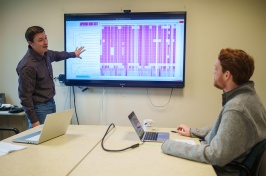
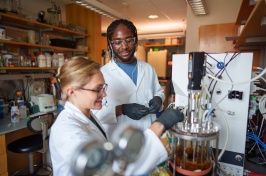
When he is not lecturing or teaching aerobics, Cote, a senior researcher
in the Biochemistry and Molecular Biology Department, heads up a
team of undergraduate and graduate students, post-doctoral researchers,
and technicians investigating the biochemistry of vision.
It is as a researcher that Cote entertains his passion for unlocking
the secrets of proteins and enzymes, which began in his graduate
student days at the University of Wisconsin. “People wonder
why I work so hard. I do it because I really love what I do,”
he said.
His research, funded by the National Institute for Health, focuses
on the enzymes controlling the initial steps of the vision process.
“We are looking at the very first reactions that occur whenever
you see something,” he said.
Cote’s work is critical to understanding how the proteins
that control the vision process function normally. Once this is
achieved, Cote hopes that scientists will better understand what
goes wrong in the retinas of people who experience visual disorders
or a total loss of vision. “Our research on the proteins critical
to the visual pathway ultimately will help arrest or prevent some
retinal degenerative diseases that result from defective versions
of these proteins,” Cote said.
Cote also believes that his research plays a vital role in his success
in the classroom with undergraduate and graduate students. “My
research keeps my teaching fresh because it keeps me up to date
with all the new advances in biochemistry, instead of simply teaching
the same thing out of a textbook year after year,” he said.
Whether in his role as a professor, researcher, aerobics instructor,
father, or domestic partner, Cote invests each with equal energy.
“It can be a bit schizophrenic, trying to juggle the lab,
classroom, and aerobics studio with a commitment to being a great
father and loving partner at home. Let’s just say I don’t
sleep too much!”
|